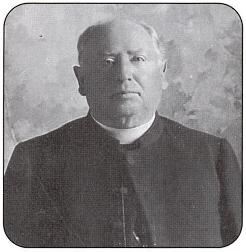
In July 1894, a humble priest arrives from Fargo to assume the spiritual leadership of the local Catholic parish. Who would have predicted he would have such a significant impact to the city? Consider in 1907 when Mandan renamed its streets and avenues, the only non-numeric titles assigned were "Main" and "Collins."
Daniel Collins was born on January 15, 1841 in County Cork, Ireland. His father passed away when Daniel was only three years old. At the height of the Irish Potato Famine in 1847, he and his mother immigrated to the United States to Cleveland, Ohio. He was later placed in the care of the Christian Brothers and attended the first Catholic grade school in the city.
With increasing local unrest preceding the Civil War, he was moved to Wheeling, WV where responsibility for his well being and education was formally accepted by its first Catholic bishop, His Excellency Richard V. Whelan. He continued his studies at St. Mary's Seminary in philosophy and theology. On September 8, 1868 he was ordained in St. Joseph's Cathedral, Wheeling. He performed frontier mission work for twelve years under the direction of the imfamous Bishop Whelan and his successor in the West Virginia frontier. He had also been chaplain of the Home Guards of Cleveland at the onset of the Civil War.
In 1880, Bishop Martin Marty, first Catholic bishop of Dakota Territory, invited him to join in the mission work in the west. While ministering in the southern counties of Dakota Territory, "Captain" Collins served as chaplain of the Second Regiment of the Dakota Territorial National Guard of Elk Point. Due to his successes in what is today South Dakota, he was promoted to the pastorate of St. Mary's Church in Fargo, DT. He remained in Fargo six years. In July 1894, he was transferred to St. Joseph's Catholic Church in Mandan as its pastor taking over for Father John A. Lemmieux.
The original congregation was heavily comprised of Irish-heritage railroad construction workers and their families. But by 1892 German's from the Ukranine began arriving in Morton County drawn by homestead opportunities. Railroad land agents specifically targeted German farmers because of their industrious reputations. Church records indicate requests for a German priest and the use of the German language in services in confirmation instruction. However the French-American was replaced with an Irish-born priest.
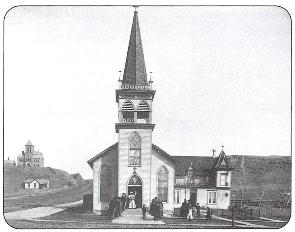
The previous church building
Father Collins quickly identified the need for larger physical facilities to serve the expanding parish. He undertook the task of securing funds for and the actual construction of the ninth church in his career. The selection of German-born Anton Dohmen to design the church may have been an attempt to address the desire for more German influences in the operation of the parish. Father Collins personally loaned $13,500 toward the $40,000 cost of the new church building. While a new rectory was also started, work on it had to be temporarily suspended due to limited funds.
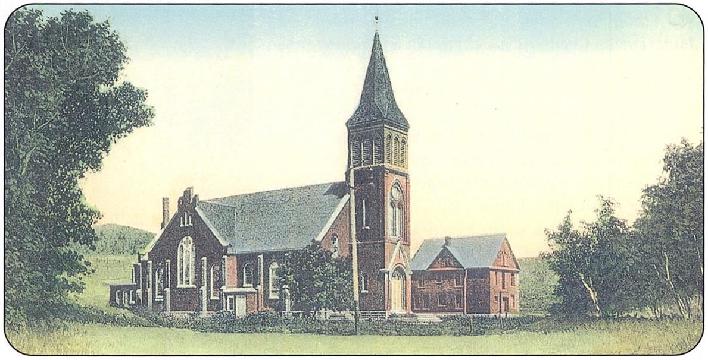
The current St. Joseph's church building and former rectory circa 1924
Father Collins died unexpectedly at age 68 on September 13, 1909 due to pneumonia aggravated by a heart condition. He had celebrated the fortieth anniversary of his priesthood only days prior. His funeral held in Mandan was the largest the city had ever seen. The Reverend Thomas Egan of Fargo challenged the people of Mandan to "always remember the loyal and heroic service of Father Collins." Reverend Edward Geraghty of Jamestown remarked that the church would stand as a lasting memento to his untiring zeal and generous nature.
He had expressed his desire to be buried beneath the church. Following the funeral, his body was buried in Union Cemetery. In February 1911, his coffin was exhumed and his remains were moved to a vault located in the church's basement.
In his will, he cancelled the $13,500 remaining on the on the note. He also gave a few lots in that area of the city to the bishop to be used for the good of the parish. The $14,500 total value of this bequest is worth an estimated $330,000 in 2008 dollars. Father Collins was a power for his parish, the community and Morton County. It was said he was universally loved and respected by all who had contact with him, regardless of religion. He was energetic, outspoken and a man of exemplary life with a mission of "Peace on Earth, Good Will to Men."
Notes: Father Daniel Collins shares his name with the Daniel Collins who was appointed Justice of the Peace during the first meeting of the Mandan Village Trustees on February 28, 1881. This Daniel Collins was a successful Morton County farmer, early Mandan promoter, and later presided over the murder trial of the Marquis de Mores held in Bismarck from September 12-19, 1885. Father Collins did not arrive in Mandan until 1894.
The MHSoc's museum and office is located at 3827 30th Avenue NW; Mandan, ND 58554 Contact us at info@mandanhistory.org