MANDAN Historical Society

Working to Preserve & Promote Mandan's Heritage since 2004

Welcome

Membership

Activities

Mandan Museum

TR-Coe Exhibit

WWII Exhibit

Beanery Museum

Biographies A-D

J D Allen

Franklin Anders

Richard Baron

George Bingenheimer

William Block

Philip Blumenthal

Elijah Boley

Frank Briggs

Leo Broderick

William Broderick

Lyman Cary

James Clark

Henry Coe

Daniel Collins

Elizabeth Custer

George Custer

Alice Dahners

Henry Dahners

C E V (Charles) Draper

Esther Davis

Tony Dean

Joseph Devine

Biographies E-O

Ronald Erhardt

John Forbes

Palma Fristad

Gilbert Furness

Aloysius Galowitsch

Frederic Gerard

Zalmon Gilbert

Charles Grantier

James Hanley Jr

James Hanley Sr

Mary Harris

Michael Lang

William Langer

Albert Lanterman

William Lanterman

John Lockwood

Richard Longfellow

Rolland Lutz

Hiram Lyon

George Marback

Gary Miller

Lee Mohr

Margaret Naylor

John Newton

Anton Ness

John Osterhouse

Biographies P-Z

George Peoples

Arthur Peterson

Nels Romer

Hoy Russell

Antonie Rybnicek

Ervin Rybnicek

Hynek Rybnicek

Margaret Schaaf

George Shafer

Erica Schroeder

William Simpson

Anna Knox Stark

Mary Stark

J O Sullivan

John Sullivan

Era Bell Thompson

Andrew E. Thorberg

Ida Johnson Thorberg

George Toman

Earle Tostevin

Edwin A Tostevin Sr

Edwin D Tostevin Jr

Walter Tostevin

Felix Vinatieri

A B Welch

Levon West

Harry Wheeler

What's New

Area History

Mandan Rodeo / Fair

The 1880s

School Systems History

The 1890s

The 1900s

1901 Pan Am Expo

1903 TR Visit to NDak

The 1910s

1911 Fair & Airplane Demo

The 1920s

Prohibition in Mandan

The 1930s

FDR Visit August 1936

The 1940s

The 1950s

1958 Lincoln Stamp FDC

Custer Drama / Trail West

The 1960s

The 1970s

The 1980s

The 1990s

1st of the 21st

2010-Present

Area Landmarks

Cary Bldg - Mandan Drug

Christ the King Church

Collins Av Civic Bldg

First Lutheran Church

First National Bank Bldg

First Presbyterian Church

Lewis & Clark Hotel

Mandan Hill

Mandan Theatre

MV Produce Warehouse

Methodist Church

NP Beanery

NP "Colonial" RR Depot

NPRR Freighthouse

NP Rail High Bridge

Roughrider Statue

St Joseph Church

Great Plains Expermt Stn

WWar Memorial Bldg

Youth Correctional Center

Gone Forever

Collins Ave Courthouse

Cummins Building

Deaconess Hospital

Eielson Field

First St Federal Building

Havana Club

Hotel Nigey

InterOcean Hotel

Liberty Memorial Bridge

Mandan Creamery & Produce

NP "Queen Anne" Depot

Original Passenger Depot

Peoples' Hotel

Russell-Miller Mill

Rock Haven

Young's Tavern

Heritage Homes

Stuart Dunlap Home

Ellis-Uden Home

Freeburg-Esser Home

Lyon-Weigel Home

Olson-Brick Home

Parkins-Cooley Home

Stutsman-Wyatt Home

Swanson-Reichman Home

Welch-Ness Home

View Collections

Artifacts - Miscellanous

Newspapers

Pottery and Glass

Photos - Buildings

Photos - Downtown

Photos - Floods

Photos - People

Photos - Rail and Trains

Genealogy Links

Endowment Fund

NP Railway Missouri River "High" Bridge
The Northern Pacific (NP) Railroad announced in 1879 that it would push west with the addition of 200 miles of line to the Yellowstone River near present day Glendive Montana.  While ferrying across supplies was a expensive temporary solution, bridging the "Big Muddy" would be required to complete a northern branch of a transcontinental rail line.

The Missouri River narrowed north of Bismarck.  Construction of a of a levy could sweeze the river together further. Still, three separate bridge spans each 400 feet in length would be required to connect two land-supported approaches at each end.  Announcement of the projects prompted an influx of thousands of workers to the area.  And the location of the work camp which would someday become Mandan was set.

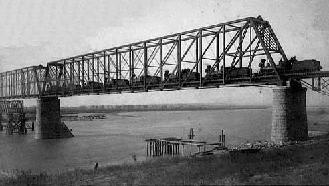
Original Bridge Superstructure 1882
The name "High Bridge" refers to the 70-foot river clearance intended to protect the structure from the dual danger of widely fluctuating river levels and the huge chunks of ice common in early spring on the Upper Missouri River.  George S. Morison also incorporated into the design metal sheaths or blades on the upstream side of the piers to break up the ice sheets.

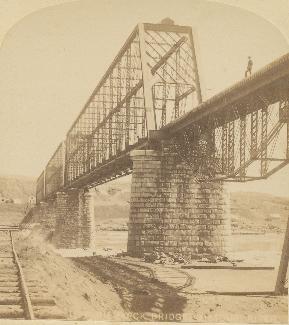
The bridge relies on piles driven into the sand and river bottom and the construction of stone piers  upon which the bridge deck rests.  To build the piers, caissons measuring 74 feet by 25 feet by 17 feet high were fabricated from timber and iron, were floated into position and then sunk.  Concrete was poured into the casison, filling it above a false floor and pushing the caisson into the river bottom.  Men would enter a hollowed portion of the caisson bottom through an airlock.  These workers would dig into the river bottom allowing the caisson to continue to sink.  Eventually the caisson reached a firm layer and further excavation stopped.  Granite piers were subsequently built upon the caisson footers.

NPRR Photo October 1882
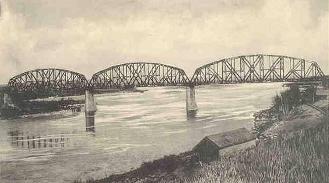
1907 RPPC of NP High Bridge
Work began on the bridge on September 1, 1881. The east approach span was finished May 9, 1882.  The west approach span was completed June 3, 1882.  The center span was completed October 18, 1882.  The final cost was $1.08 million.  Between 200 and 600 men worked on it at any given time, dependant on what aspects of the bridge were under construction.

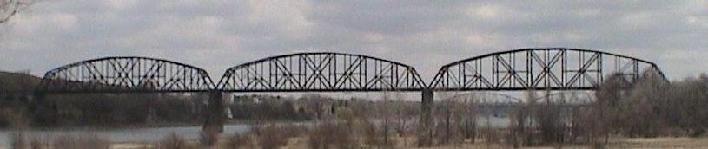
The first spans were flat topped but were replaced in 1905 when the loads which could be transported by improved locomotives exceeded the capacity of the initial design.  The bridge trusses were rebuilt atop the existing piers using sturdier and elegant arc-topped spans which remain in service today.

The BNSF "High Bridge" in 2008

The MHSoc's museum and office is located at 411 W Main St, Mandan, ND 58554
Contact us at info@mandanhistory.org or leave message at 
(701) 751-2983


Last Updated 01/02
/12    ©  2006-2012  Mandan Historical Society  All rights reserved