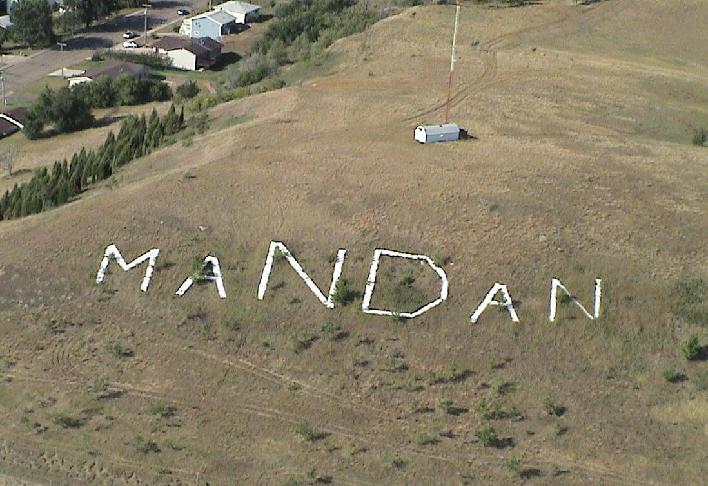
East Mandan Hill as it appears from the air in Summer 2008 including KNDR radio tower and equipment shed.
Mandan Hill, or frequently referred to as "Crying Hill", has welcomed visitors and returning residents with its notation for almost 100 years. The landmark is comprised of three separate features; (1) concrete letters denoting the city's name on the northeast face of the hill; (2) the word "Mandan" spelled out in trees on the south face of the hill; and (3) the hill itself, a sacred place culturally important to several Native American tribes.
In the 1920s, small towns across the state and probably across the country adopted the practice of recording its name on a nearby hillside. Similar efforts were undertaken by other North Dakota towns including Bowman, Center, Kathyrn, and New Salem whose signs also remain intact today. In the days before GPS coordinates and radio navigation aids, the forerunner to the ND State Aeronautical Commission encouraged rural areas to denote their community's name on watertowers and hillsides to assist airplane pilots in identifying their location during cross-country flights. Another version of the truth attributes the practice to plain civic pride.
The first sign was completed in 1929 by the local Boy Scout troup transporting discarded blocks of pavement they commandeered from the Sixth Avenue NW widening project. Whitewash was provided courtesy of a nearby blacksmith shop.
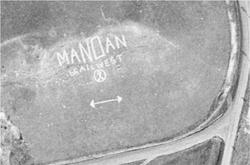
In 1932, Mandan Pioneer newspaper editor Edwin Tostevin suggested for a larger, more substantial version of the sign during a meeting of the Mandan Lions Club. After a two year effort, civic leaders stepped up to formally adopt it as a civic project. Again, the Mandan Boy Scouts lead the effort to complete a 300 foot long by 70-foot-high sign on the south side of Mandan's Crying Hill in June 1934. Area businesses sponsored the forty-seven truckloads of rock which were delivered to the base of the hill. The stones were collected from fields around the city. The Boy Scouts applied more than 12 gallons of white paint to the stones to brighten the letters. Mandan's layout features the two middle characters as upper case letters 85 feet high to represent the state's of North Dakota's official abbreviation. The local Boy and Girl Scouts maintained the sign for 30 years.
Click to Enlarge
In June 1959, work was again completed on refurbishing and replacing stones and repainting the sign. Railroad ties were added to the display which denoted "Trail West" to promote the new Custer-based drama debuting at Fort Lincoln State Park in July 1959.
The project was sponsored by the Mandan Jaycees with member Larry Sullivan serving as project chairman.
In August 1963, eight gallons of paint and 12-hours of effort by the Mandan Jaycees members went into rehabbing the sign. A second line consisting of white painted railroad timbers was added to promote the Custer Drama at Fort Lincoln State Park.
In August 1974, 26 members of Mandan's TOPS (i.e., take off pounds sensibly) Club 17 trudged up the bluff (along with a few of their husbands) to replaced missing rocks spelling out both "MaNDan" and "MHS." White paint was provided by the local Chamber of Commerce to help completed the referbishment.
With the construction of Interstate 94 on the north side of the hill, the original white-colored sign was transferred from the hill's southern side to the east side in 1987 to be viewed by approaching traffic. Instead of using stones, large concrete rectangles were constructed. This designed was expected to discourage vandals from removing stones and/or destroying the letters.
The marker is credited currently as being the largest sign in North Dakota.
As part of North Dakota's centennial celebrations, Mandan joined other cities in the state to plant a "Centennial Forest." Trees were planted in 1989 across the original location of the sign, i.e. the southern face of the hill, also spelling out "MANDAN."
In September 2024, Doosan Bobcat employees volunteered and cleared the trees and brush around the existing letters.
2025 Proposed Replacement
Originally the plan was to scrape and repaint the concrete panels in Spring 2025. But their current condition demands more of an effort.
Three Affiliated Tribes currently owns the property under the letters M, A, N, and D. The City of Mandan own the land under the last two letters: A and N. The City approached the Three Affiliated Tribes to jointly sponsor the project, and they are in general agreement with the need to update the lettering.
A group of residents and city staff and leaders to develop a specific plan for the project. The Four Directions group at Mandan High School suggested "Honoring the past. Healing the future." as the theme for the project. A landscape architect was engaged. The preferred concept alternative involves 20-feet high and 130 feet wide and includes LED lighting to illuminate the sign. The estimated cost is $1.2 million. City leaders are now soliciting private funds to sponsor the project.
Crying Hill
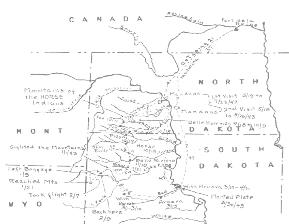
The first European explorers, sons of the famous French explorer Pierre Verendrye, were reportedly greeted in 1738 by Mandan indian chief Good Fur Blanket just below the south side of the hill. However the greater significance stems from its importance to multiple Native American Indian tribes. The Mandan, Hidatsa, Lakota, Sioux, and Arikara tribes all attribute sacred events and rituals of taking place there.
Click to Enlarge for Route Map
As the highest place in the area, Crying Hill was frequently sought out as a place for prayer and solace; possibly asking for a healthy baby by pregnant women; or a attempting a “vision quest” seeking guidance from a departed loved-one.The area was also used by Native Americans from the region to mourn their dead. Whether its importance is of cultural significance, or evokes fond childhood memories sledding down its slippery snowing slopes, the place is a true historic landmark.
The MHSoc's museum and office is located at 3827 30th Avenue NW; Mandan, ND 58554 Contact us at info@mandanhistory.org