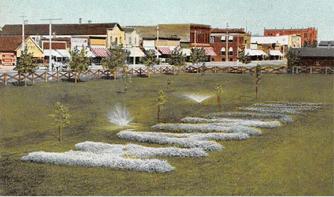
In 1910, the city saw the completion of a new hospital, the completion of the initial portions of a city sewer system, a major extension of the drinking water mains and the opening of the city's first park. The Northern Pacific Railway also added hundreds of miles of track as its southern branch was completed into the communities of Flasher, Elgin, New Leipzig and Mott.
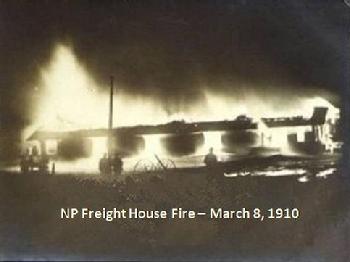
The NP Railway east freighthouse, filled to capacity with flammable materials, was destroyed by fire on March 8. Despite efforts by Chief Dave Taylor and his volunteer firemen, the water pressure was inadequate to contain the fire with three lines. Losses were estimated at $30,000 ($1,015,000 in 2025$) for the building and its contents. A string of 12 boxcars alongside also caught fire, but were moved and extingiushed. The lumber shed of the Bingenheimer Mercantile were also saved.
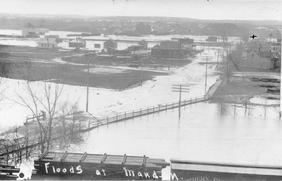
The early breakup of the Missouri and Heart Rivers in March brought the highest watermark for flooding in the city since 1881, suspending mail and rail connections with the east. The 1910 spring flood prompted the NP Railway to build their new freight house & passenger depot on west Main St. (current the Morton-Mandan Public Library).
See adjacent webpage [Area History] --> [1910 Spring Flood] for more information.
Click to Open
The following summer, newspaper reports of packs of wild dogs "over run the town ... seen out in the street opposite the Pioneer block ... is a disgraceful scene for travelers arriving by train at the Depot."
Ladies of the city asked the City to compel bathers in the Heart River to wear swimsuits as they were shocked at the "frank nudity" they displayed. White Star Livery, owned by E. McAuliff, boasted a new brougham, a coupe and a cabriolet horse carriages from the Twin Cities but it would not be enought to reverse the downward demand resulting from the introduction of the automobile.
A major thunderstorm with large hail swept through the county on June 9, 1910. Hailstones were large enough to kill "good-sized" pigs. Crop damage and buildings destroyed throughout Morton County. The evening's rainfall was measured at 0.95 inches.
The last serious attempt to sub-divide Morton County occurred in October 1910. The Glen Ullin News newpaper championed the cause, proposing to split the county from north to south and promoted it's city as the new county seat. However the citizens of Flasher, supported by its local newspaper the Flasher Hustler, their proposal was to spilt the county on an east-west line making its town as county seat.
1911
The Missouri Slope Fair featured "Lucky Bob" St. Henry with his Curtiss biplane "Sweetheart."
Thousands attended the Fair to witness the demonstration, including passengers arriving on a special train from Bismarck.
A new waterworks pumping plant was installed and associated piping by the G. W. Haggart Co. of Fargo for a bid price of $74,141 ($2.6 million 2025$).
The year 1911 saw more creameries and more dairy cattle added to Morton County. Through the application of dry farming methods, hundreds of farmers harvested crops that paid well. The city of Mandan with a population near 4,000 continued to prosper.
1912
In March and April, city residents fought rising waters of the Missouri River, and later the Heart River. Water overflowed into Girard's Addition, Minor flooding also occurred in the Syndicate residental district, with the entire fairgrounds under water.
Upon vote of the City Commission, all downtown businesses were forced to connect to the sanitary sewer system when operation of outhouses were condemned.
On August 21, the first Boy Scout troop was established when the Episcopal Church sponsored Troop Number 1. William Cummins, one of its members, achieved "First Class Scout" status on May 22, 1915, possibly the first member in the Missouri Valley Council to achieve the distinction.
In October, Theodore Roosevelt would again return and speak to area residents with a "whistle-stop" at Mandan's Main Street depot during his campaign as the Progressive i.e. Bull Moose Party presidential candidate. Woodrow Wilson would defeat both incumbant Howard Taft and Roosevelt. (See webpage [Area History] ==> [1912 TR Whistle Stop Visit] for more information).
1913
In June, one of the most spectacular fires that ever occurred in Mandan completely destroyed the elevator of the Haight Lumber and Machinery Company, and caused a loss of $8000 ($275,000 in 2025$). Fire broke out about 2:00 PM after lightning struck the elevator's tower during a heavy thunderstorm. The stream of water from the fireman's hoes was unable to reach the top of the structure allowing the fire to work its way down, completely out of control. Within two hours, the building was in total ruins. According to Mr. Lanterman the owner, about 67% of the loss will be covered by insurance.
The greater portion of the former Fort Abraham Lincoln and adjacent property for a total of four acres were deeded to the State of North Dakota in July 1913 and remains a state park today.
1914
Click to Enlarge
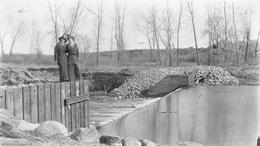
Efforts to dam the Heart River started as early as 1908, when the State Reform School (today's Youth Correctional Center) applied to use water to irrigate its land. With support from the Mandan Chautauqua Association and the Russell-Miller Milling Company, a dam was installed on the west side of the city. The 160 foot long steel and concrete dam was larger than originally proposed and included a 90-foot wide spillway.
The cost of the dam was $5,671 ($186,000 2025$). With $2000 of state funding, the Mandan Commercial Club spearheaded the effort to raise the remaining funds from local sources. Raising the river 7 feet, a reservior between 2.5 to 3 miles long was created behind it.
The dam was completed just in time to control a record river flow of nearly 6500 cubic feet per second on June 27 resulting from a cloud burst the day before. The prior high river flow was approximately 6100 cubic feet per second in June 1904.
1915
A proposal to organize western North Dakota and eastern Montana into a new state was advanced by Morton County Senator Martin who claims that eastern cities were "hogging the educational institutions."
John Mushik and A.S. Brazada co-located their shoe shop and clothing/tailor operation in the Williams Building, just east of L.N. Cary's office on West Main St.
1916
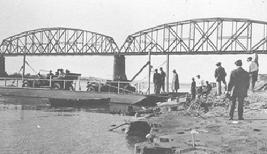
The Mandan Automobile Club and the Bismarck Commercial Club purchased the river ferry operated by Walter Gossard. The city boosters paid Gossard $2000 as a down payment on the gasoline ferry and began a campaign for the $1300 balance. The Bismarck and Mandan clubs formed a stock corporation capitalized at $2000. Daily income was in excess of $25 per day, with the expectation to repay the stock subscriptions by summers end.
Missouri River Car Ferry 1909
The city's drinking water quality issued continued. Various citizens who declared they 'are willing to pay for water service, but not the mud they are currently getting!' Many citizens had to lug water from the remaining old waterwells despite the installation of a "modern $80,000 waterworks system" in 1912. For example, Mr. T.J. Logan of the Golden West Laundry Co. installed a well at a cost of $1300. The three month effort bored to a depth of 390 feet and with the aid of pumps is furnishing 1,000 gallons per hour of good water. The company been temporarily closed since July after the city's muddy water prevented laundry from being washed clean. The artesian well was temporarily suspended in August 1916 to retrieve a tool down the well. The project was scheduled to be completed in 12 months, by May 1891. Total funds raised by sale of bonds for the project was $10,000. The Mandan Board of Health began enforcing the city's ordinance that all residents use sealed garbage cans to manage their trash.
On November 28, Morton County was split into two. Grant County was established with its seat in Carson from the land in southwest half of the county.
1917
In January, on orders from the ND Supreme Court, Sheriff Oscar Olson smashed open 96 50-gallon wood barrels of claret stored in the basement of the Morton County Courthouse for over a year and a half. The Supreme Court handed down the decision ordering the wine destroyed. The liquor was seized by States Attorney Langer from Hebron-area residents. Ownership of the wine was the focus of six different court proceedings before the highest court finalized the action.
In support of the war effort, the Northern Pacific Railroad decided to convert the 5 acre park, south of Main Street and adjacent to the depot into a vegatable garden. The park has been developed into one of the most beautiful parks along the route from St. Paul to the west coast. Once word got out, local businessmen were indignant. P.W. Gillic offered alternate acreage to serve the purpose and preserve the park and its impact to the downtown area.
The Mandan City Commission considered a petition by the Mandan Commercial Club to construct a levee around the Syndicate and Dogtown, i.e., southwestern and southeastern parts of the city. According to the petition, property owners are requesting a dike be constructed from the Northern Pacific bridge at the place where it crosses the Heart River and what is known as First Crossing at the west end of the city, following along the north bank of the Heart River to the place where the south branch of the Northern Pacific railroad crosses the Heart River.
(NOTE: The US Army Corps of Engineers would design and install a series of levees in the 1950s to protect these areas of town.)
1919
In July, work started on the concrete foundation of the Western Auto Company building. The concrete was poured to a depth of 11 feet and two feet in thickness to expand to as many as five stories. The 100 x 140-ft. garage was built on the southwest corner of 2nd Ave NW and 1st St NW, across from the Daily Pioneer office. The existing house on the lots was purchased from L.N. Cary by Albert Lanterman, and it was moved onto the lot adjacent to the E.R. Lanterman residence on 3rd Ave NW.
Some information presented on this page is based on the research conducted by Diane Boit on assignment to the Mandan News in her weekly "Those were the Days" columns.
The MHSoc's museum and office is located at 3827 30th Avenue NW; Mandan, ND 58554 Contact us at info@mandanhistory.org